
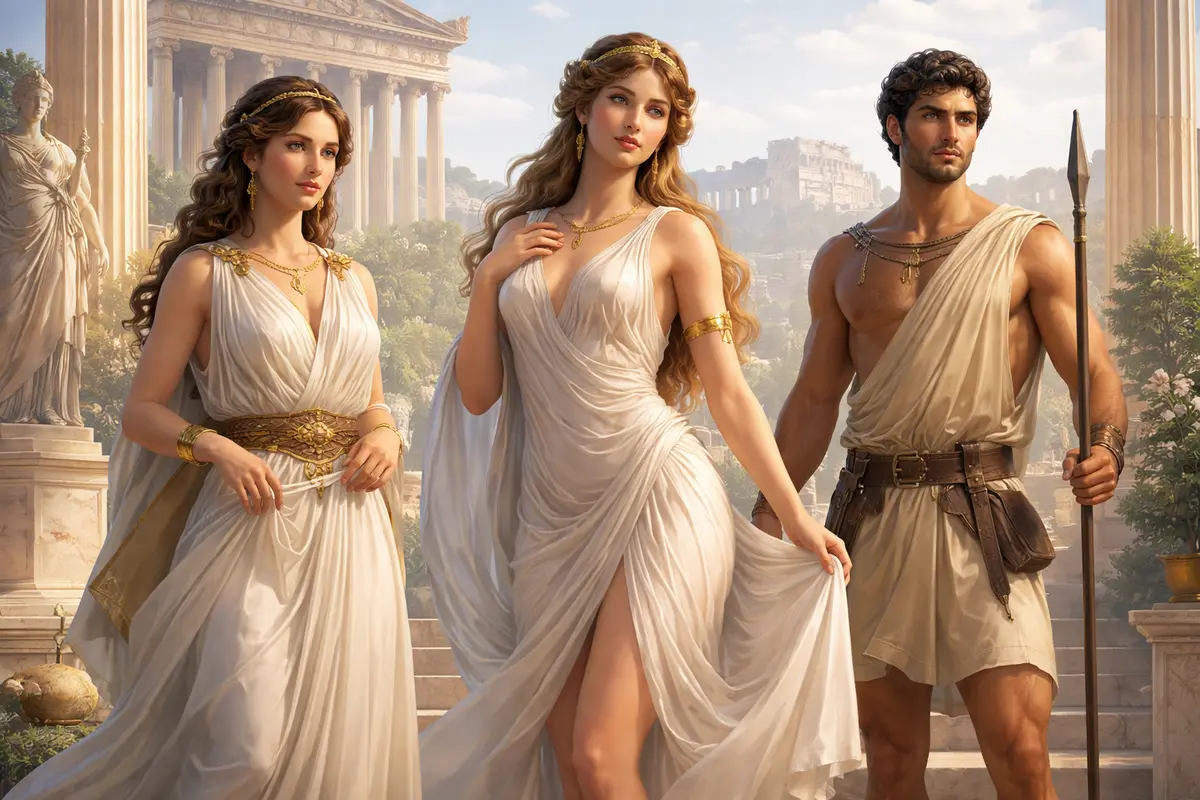
The chiton garment is one of the most important and recognizable forms of ancient Greek clothing. Worn for centuries by men, women, and even depicted on the gods, it was more than simple attire—it was a symbol of Hellenic identity and craftsmanship. As a foundational ancient Greek garment, the chiton shaped how people dressed, moved, and expressed status in classical Greece, and its influence continues to appear in contemporary couture.
What Is a Chiton Garment?
Structure and Composition
The chiton definition refers to a tunic-style garment worn in ancient Greece. To define chiton more precisely, it was made from a single rectangular length of linen or wool draped around the body and fastened at the shoulders and sides. The meaning of chiton comes from its role as a practical yet elegant solution to everyday clothing needs.
Unlike modern clothing, a chiton was not sewn. Instead, it relied on pins, belts, and folds to create shape, allowing flexibility and comfort. When belted, excess fabric could be drawn upward to create a distinctive bloused effect known as the kolpos, a defining feature of how a chiton was worn.
In the context of ancient Greek clothing, the chiton was the most common everyday garment. When people ask what are chitons, they are referring to variations of this same tunic-style form, which differed in length, fabric weight, and draping method depending on gender, occasion, and social status.
History of the Chiton in Ancient Greece
Chiton as an Ancient Greek Garment
Historians view the chiton as the foundational element of Greek dress. As a garment of ancient Greece, it appeared during the Archaic period and remained in continuous use through the Classical and Hellenistic eras. While materials, draping techniques, and decorative details evolved over time, the essential form of the chiton remained remarkably consistent.
This ancient Greek garment was worn in daily life, public gatherings, religious ceremonies, and even athletic contexts, making it one of the most versatile forms of dress in Greek society.
Greek Clothing History and Cultural Significance
Within Greek clothing history, the chiton represents a balance between simplicity and refinement. Examining how did ancient Greeks dress reveals a culture that valued proportion, harmony, and ease of movement. The chiton allowed the body to move freely while maintaining a sense of order and dignity.
As part of Greek ancient fashion, the chiton shaped artistic representation in sculpture and pottery and later influenced Western concepts of draped clothing and classical aesthetics.
Types of Chiton Garments

Doric Chiton
The Doric chiton is one of the earliest and simplest forms of the garment and was usually made of wool, giving it a heavier and more structured appearance. A Doric chiton dress was typically sleeveless, fastened at the shoulders, and worn with minimal shaping.
A defining feature of the Doric chiton was the apoptygma, an overfold created by folding the upper portion of the fabric down so that it hung over the chest. This overfold added both visual weight and decorative emphasis, reinforcing the clean, architectural lines that characterize the chiton Doric style.
Ionic (Ionian) Chiton
The Ionic chiton, also known as the Ionian chiton, was made of linen, making it lighter, softer, and more fluid than the Doric version. Instead of being sleeveless, the Greek Ionic chiton appeared to have sleeves.
These “sleeves” were not cut or sewn. Instead, they were formed by pinning the fabric at regular intervals along the arms, creating a series of openings that allowed the cloth to drape gracefully. This construction gave the Ionic chiton its flowing silhouette and associated it with elegance, refinement, and artistic sophistication.
Chiton Garment for Men and Women
Chiton Clothing for Women
Chiton clothing female styles were typically floor-length or ankle-length, creating a long, flowing silhouette. A Greek chiton female garment was often belted to form soft vertical folds that emphasized movement and balance. As part of ancient Greek women’s clothing, the chiton could be worn alone or layered with other garments for warmth or modesty.
In ancient Greek attire for women, the chiton conveyed grace and proportion while remaining practical for daily life.
Chiton Clothing for Men
Chiton clothing male versions were generally shorter, often falling to the knees to allow greater freedom of movement. A common variation was the exomis, a type of chiton worn with one shoulder left bare, which was especially practical for laborers, craftsmen, and soldiers.
In ancient Greek clothing male traditions, the male chiton reflected functionality, simplicity, and adaptability across different social roles.
How the Chiton Was Made and Worn
Fabric, Construction, and Fit
The chiton was essentially an ancient Greek tunic, also known as a Greek tunic or ancient tunic. Most chitons were made from linen, making the linen chiton light and breathable—ideal for the Mediterranean climate.
As a tunic Greek garment, the chiton was not tailored but shaped through draping.
Pins, Belts, and Draping Style
To secure the chiton, wearers used a dress clasp or messenger pin at the shoulders. An ancient Greek belt was tied around the waist, sometimes pulling the fabric up over the belt to create a bloused effect.
These elements allowed customization while keeping the garment simple.
Chiton and Other Ancient Greek Clothing
Chiton vs Peplos
The chiton vs peplos comparison highlights key differences in construction and appearance. The peplos was a heavier, simpler tube of wool, typically worn by women and fastened at the shoulders with minimal shaping. In contrast, the chiton was more voluminous and fluid, allowing for greater variation in draping, belting, and movement.
In peplos ancient Greece, the peplos conveyed restraint and tradition, while the chiton offered flexibility and visual softness.
Chiton vs Himation
The himation was a cloak worn over the chiton rather than a replacement for it. In himation Greek clothing, it provided warmth, modesty, and an added layer of formality. The himation vs chiton distinction lies in function: the chiton served as the base garment, while the himation acted as outerwear.
Chiton vs Toga
The chiton vs toga contrast reflects fundamental differences between Greek and Roman dress. While the chiton was a rectangular Greek staple, the Roman toga was a massive, semi-circular garment reserved for formal, civic occasions. This distinction clearly defines toga vs chiton usage, emphasizing the chiton’s practicality versus the toga’s ceremonial role.
Chiton in Greek Mythology and Art
Greek Gods and Goddesses Clothing
In art and sculpture, Greek goddesses’ clothing often features flowing chitons. Many ask what Greek gods wear or what Greek goddesses wear, and the answer frequently includes the chiton paired with a himation.
Chiton in Greek Mythology
The chiton Greek mythology connection appears in depictions of deities like Athena and Aphrodite. An Aphrodite outfit, for example, is often shown as a soft, draped chiton symbolizing beauty and grace. In classical sculpture, the ‘wet drapery‘ technique was famously used to show the thin linen of an Ionic chiton clinging to the form of goddesses like Aphrodite, emphasizing both the fabric’s flow and the idealized human form.
Pronunciation and Common Questions About Chiton
How to Pronounce Chiton
Chiton pronunciation is commonly misunderstood. To pronounce chiton, say KY-ton (/ˈkaɪ.tɒn/). This pronunciation of chiton follows classical Greek usage. Many people search for how to pronounce chiton or chiton garment pronunciation due to its unfamiliar spelling.
Frequently Asked Questions About the Chiton
People often ask:
-
What did men wear in ancient Greece?
Answer: Most men wore a short, knee-length chiton or an exomis for labor and travel. -
What did women wear in ancient Greece?
Answer: Women typically wore long chitons, often belted at the waist, sometimes layered with a peplos or himation for modesty or warmth. -
What was women’s clothing in ancient Greece like?
Answer: Ancient Greek women’s clothing was designed for elegance and practicality, featuring draped fabrics, flowing silhouettes, and soft folds that emphasized movement and proportion.
In most cases, the answer includes the chiton as the primary garment.
How to Make a Simple Chiton (DIY Guide)
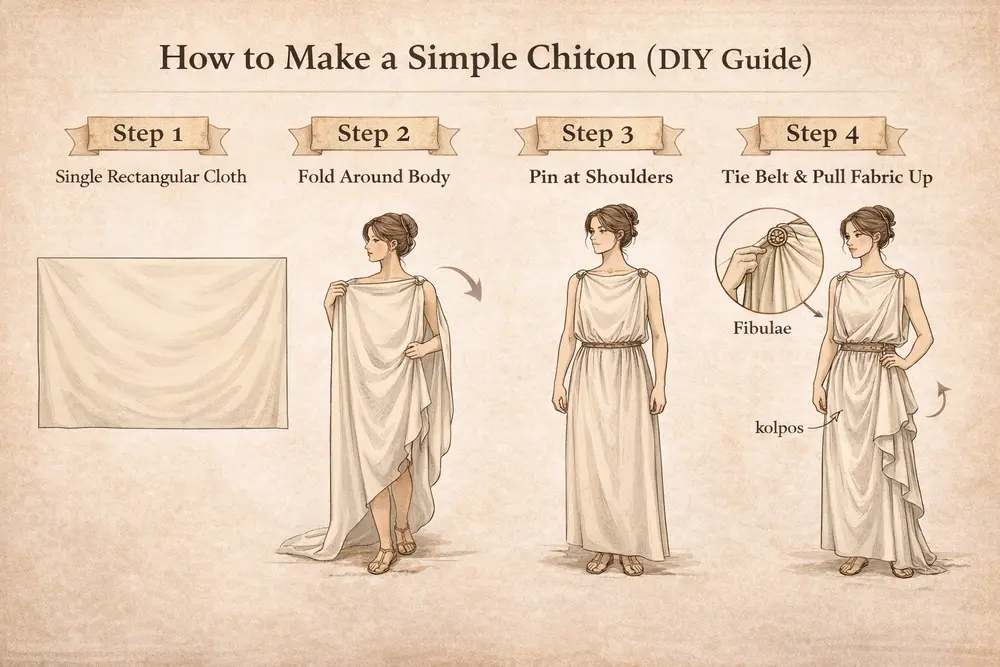
Creating a basic chiton requires minimal cutting or sewing, reflecting the garment’s original construction methods.
Step 1: Measure
Use a single piece of fabric roughly the height of the wearer and about twice the width of their armspan. Linen works best for an Ionic-style drape, while wool creates a heavier Doric effect.
Step 2: Fold
Fold the fabric vertically in half, aligning the long edges. This forms the body of the garment.
Step 3: Pin
Secure the open top edge at the shoulders using brooches, fibulae, or safety pins, leaving openings for the head and arms. Additional pins can be added along the arms for an Ionic-style look.
Step 4: Belt
Cinch the chiton at the waist with a belt or cord. Pull excess fabric up and over the belt to create the characteristic bloused effect known as the kolpos.
This simple construction method demonstrates how the chiton balanced practicality, adaptability, and elegance—qualities that helped it remain central to Greek dress for centuries.
Why the Chiton Garment Still Matters Today
Influence on Modern Grecian Style Dress
The chiton’s legacy lives on in the grecian style dress, Greek draped dress, and white Grecian dress seen in modern fashion. Designers continue to draw inspiration from the timeless elegance of the chiton garment, proving its enduring relevance.